
Tool · Moment–curvature
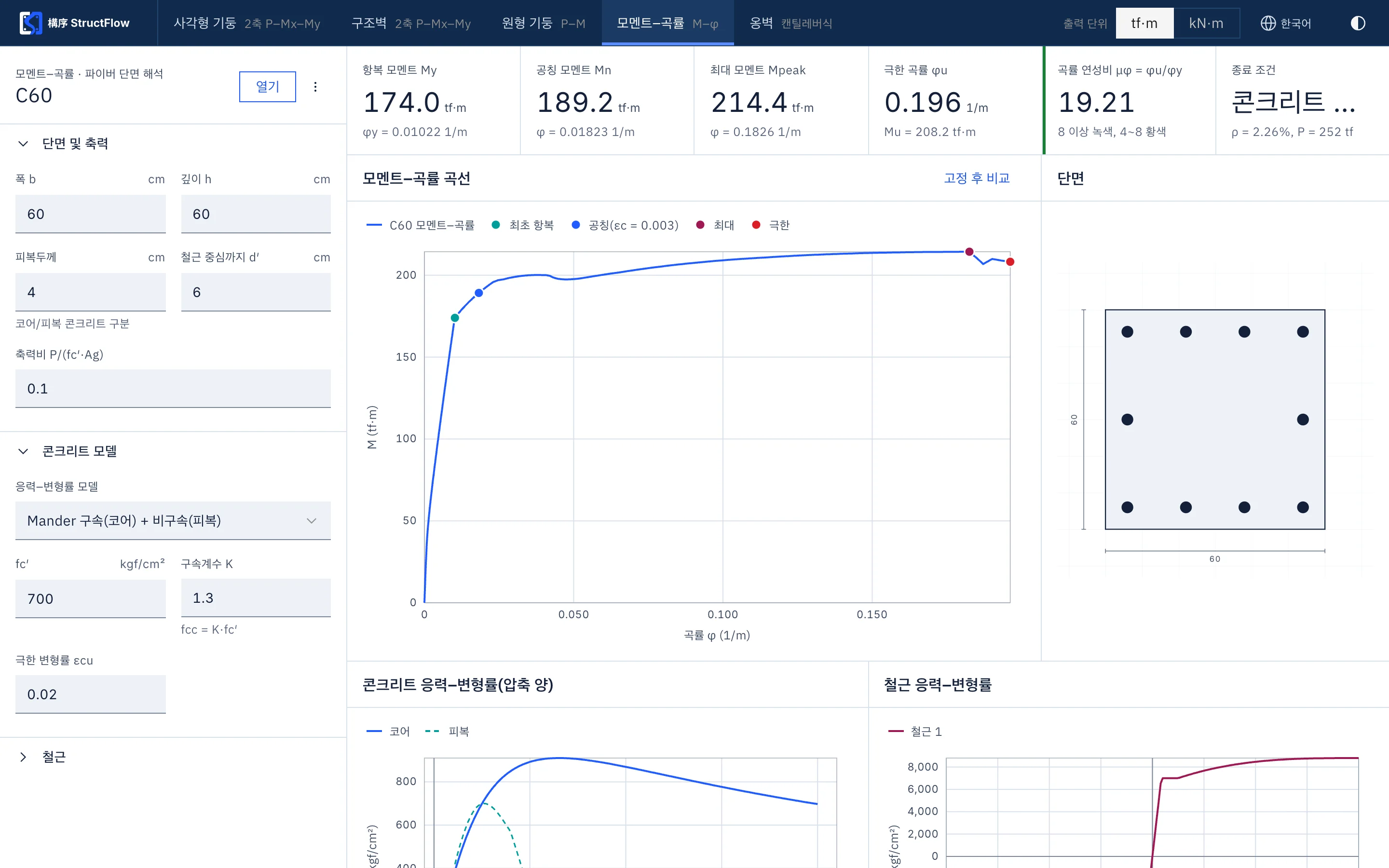
모멘트–곡률 섬유요소 해석: 세 가지 콘크리트 모델, 한 장의 그림으로 연성 비교.
피복 콘크리트와 횡구속 코어 콘크리트를 함께 고려하는 섬유요소 단면 해석으로, 항복점, 공칭점, 최대점, 극한점과 곡률 연성도 μφ를 얻습니다.
도구 화면
같은 단면, 네 가지 모델
아래 그림은 계산 엔진이 같은 단면에 네 가지 콘크리트 모델을 각각 적용하여 실제로 계산한 결과로, 구속과 섬유 보강이 극한 곡률과 연성에 미치는 영향을 한눈에 볼 수 있습니다.
참고문헌
- Mander, J. B., Priestley, M. J. N., & Park, R. (1988). Theoretical stress-strain model for confined concrete. Journal of Structural Engineering, 114(8), 1804–1826. doi:10.1061/(ASCE)0733-9445(1988)114:8(1804)
- Popovics, S. (1973). A numerical approach to the complete stress-strain curve of concrete. Cement and Concrete Research, 3(5), 583–599. doi:10.1016/0008-8846(73)90096-3
- Whitney, C. S. (1937). Design of reinforced concrete members under flexure or combined flexure and direct compression. ACI Journal Proceedings, 33(3), 483–498. doi:10.14359/8429
- ACI Committee 318. (2019). Building Code Requirements for Structural Concrete (ACI 318-19) and Commentary (ACI 318R-19). American Concrete Institute. doi:10.14359/51716937
- 內政部(Ministry of the Interior, Taiwan). (2023). 建築物混凝土結構設計規範(Design Specifications for Concrete Structures of Buildings),112 年 8 月 10 日修正發布,113 年 1 月 1 日生效. nlma.gov.tw
- 內政部(Ministry of the Interior, Taiwan). (2023). 建築物基礎構造設計規範(Design Specifications for Foundations of Buildings),112 年 6 月 20 日修正發布,113 年 1 月 1 日生效. nlma.gov.tw
- Mononobe, N., & Matsuo, H. (1929). On the determination of earth pressure during earthquakes. Proceedings of the World Engineering Congress, Vol. 9, Tokyo, 177–185.
- Sutherland, I. E., & Hodgman, G. W. (1974). Reentrant polygon clipping. Communications of the ACM, 17(1), 32–42. doi:10.1145/360767.360802
- National Center for Research on Earthquake Engineering (NCREE). 台灣新型高強度鋼筋混凝土(Taiwan New RC)專區. ncree.niar.org.tw/service/newrc
- Chiu, C.-K., Hung, C.-C., Lin, K.-C., Liu, K.-Y., Lee, H.-J., Cheng, M.-Y., et al. (2019). Design Guideline for Building of High-Strength Reinforced Concrete Structures (Draft), NCREE-19-001. National Center for Research on Earthquake Engineering.
- Hung, C.-C., & Li, S.-H. (2013). Three-dimensional model for analysis of high performance fiber reinforced cement-based composites. Composites Part B: Engineering, 45(1), 1441–1447. doi:10.1016/j.compositesb.2012.08.004
- Hung, C.-C., El-Tawil, S., & Chao, S.-H. (2021). A review of developments and challenges for UHPC in structural engineering: Behavior, analysis, and design. Journal of Structural Engineering, 147(9), 03121001. doi:10.1061/(ASCE)ST.1943-541X.0003073
- Shao, Y., Kuo, C.-W., & Hung, C.-C. (2021). Seismic performance of full-scale UHPC-jacket-strengthened RC columns under high axial loads. Engineering Structures, 243, 112657. doi:10.1016/j.engstruct.2021.112657
- Hung, C.-C., Kuo, C.-W., & Shao, Y. (2021). Cast-in-place and prefabricated UHPC jackets for retrofitting shear-deficient RC columns with different axial load levels. Journal of Building Engineering, 44, 103305. doi:10.1016/j.jobe.2021.103305
- Ou, Y.-C., Alrasyid, H., Haber, Z. B., & Lee, H.-J. (2015). Cyclic behavior of precast high-strength reinforced concrete columns. ACI Structural Journal, 112(6), 839–850. doi:10.14359/51687911
- Shen, W.-C., & Hwang, S.-J. (2023). Confinement reinforcement of high-strength reinforced concrete tied columns under high axial load. ACI Structural Journal, 120(3), 145–155. doi:10.14359/51738505
보강안의 연성을 비교하는 데 더 이상 프로그래밍이 필요 없습니다.
SUHUL EIP 계정으로 무료 가입하고 14일 동안 체험해 보십시오. 신용카드가 필요 없습니다.