
Tool · Moment–curvature
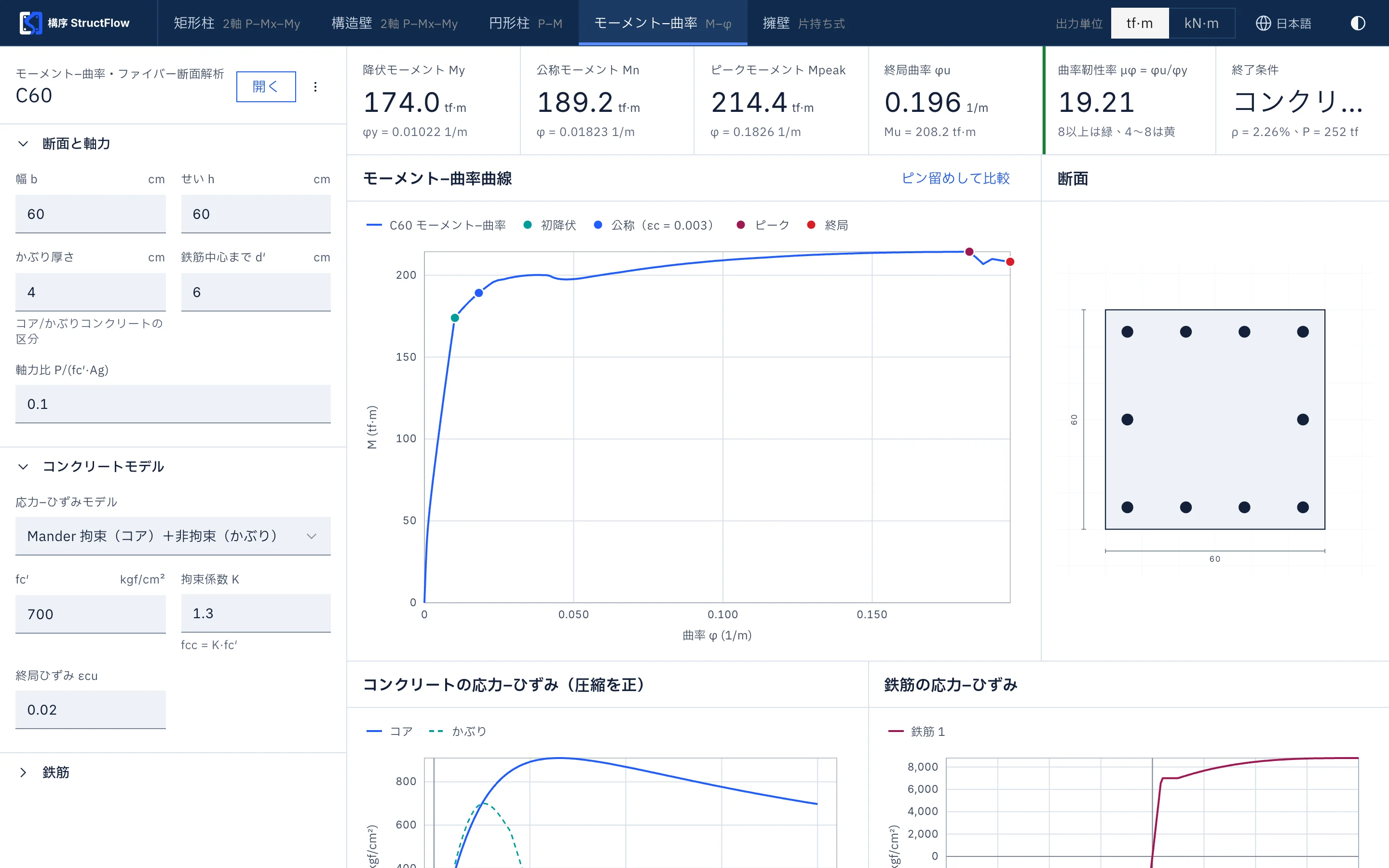
モーメント–曲率の繊維モデル解析:3種類のコンクリートモデルで、靭性を1枚の図で比較。
かぶりコンクリートと拘束された核心コンクリートの両方を考慮する繊維モデル断面解析で、降伏点、公称点、ピーク点、終局点と、曲率靭性 μφ が得られます。
ツール画面
同一断面、4つのモデル
下図は、計算コアが同じ断面に4種類のコンクリートモデルを適用して実際に計算した結果です。拘束と繊維補強が終局曲率と靭性に与える影響が一目でわかります。
参考文献
- Mander, J. B., Priestley, M. J. N., & Park, R. (1988). Theoretical stress-strain model for confined concrete. Journal of Structural Engineering, 114(8), 1804–1826. doi:10.1061/(ASCE)0733-9445(1988)114:8(1804)
- Popovics, S. (1973). A numerical approach to the complete stress-strain curve of concrete. Cement and Concrete Research, 3(5), 583–599. doi:10.1016/0008-8846(73)90096-3
- Whitney, C. S. (1937). Design of reinforced concrete members under flexure or combined flexure and direct compression. ACI Journal Proceedings, 33(3), 483–498. doi:10.14359/8429
- ACI Committee 318. (2019). Building Code Requirements for Structural Concrete (ACI 318-19) and Commentary (ACI 318R-19). American Concrete Institute. doi:10.14359/51716937
- 內政部(Ministry of the Interior, Taiwan). (2023). 建築物混凝土結構設計規範(Design Specifications for Concrete Structures of Buildings),112 年 8 月 10 日修正發布,113 年 1 月 1 日生效. nlma.gov.tw
- 內政部(Ministry of the Interior, Taiwan). (2023). 建築物基礎構造設計規範(Design Specifications for Foundations of Buildings),112 年 6 月 20 日修正發布,113 年 1 月 1 日生效. nlma.gov.tw
- Mononobe, N., & Matsuo, H. (1929). On the determination of earth pressure during earthquakes. Proceedings of the World Engineering Congress, Vol. 9, Tokyo, 177–185.
- Sutherland, I. E., & Hodgman, G. W. (1974). Reentrant polygon clipping. Communications of the ACM, 17(1), 32–42. doi:10.1145/360767.360802
- National Center for Research on Earthquake Engineering (NCREE). 台灣新型高強度鋼筋混凝土(Taiwan New RC)專區. ncree.niar.org.tw/service/newrc
- Chiu, C.-K., Hung, C.-C., Lin, K.-C., Liu, K.-Y., Lee, H.-J., Cheng, M.-Y., et al. (2019). Design Guideline for Building of High-Strength Reinforced Concrete Structures (Draft), NCREE-19-001. National Center for Research on Earthquake Engineering.
- Hung, C.-C., & Li, S.-H. (2013). Three-dimensional model for analysis of high performance fiber reinforced cement-based composites. Composites Part B: Engineering, 45(1), 1441–1447. doi:10.1016/j.compositesb.2012.08.004
- Hung, C.-C., El-Tawil, S., & Chao, S.-H. (2021). A review of developments and challenges for UHPC in structural engineering: Behavior, analysis, and design. Journal of Structural Engineering, 147(9), 03121001. doi:10.1061/(ASCE)ST.1943-541X.0003073
- Shao, Y., Kuo, C.-W., & Hung, C.-C. (2021). Seismic performance of full-scale UHPC-jacket-strengthened RC columns under high axial loads. Engineering Structures, 243, 112657. doi:10.1016/j.engstruct.2021.112657
- Hung, C.-C., Kuo, C.-W., & Shao, Y. (2021). Cast-in-place and prefabricated UHPC jackets for retrofitting shear-deficient RC columns with different axial load levels. Journal of Building Engineering, 44, 103305. doi:10.1016/j.jobe.2021.103305
- Ou, Y.-C., Alrasyid, H., Haber, Z. B., & Lee, H.-J. (2015). Cyclic behavior of precast high-strength reinforced concrete columns. ACI Structural Journal, 112(6), 839–850. doi:10.14359/51687911
- Shen, W.-C., & Hwang, S.-J. (2023). Confinement reinforcement of high-strength reinforced concrete tied columns under high axial load. ACI Structural Journal, 120(3), 145–155. doi:10.14359/51738505