
Tool · Cantilever retaining wall
片持ち式擁壁:安定性の照査から自動配筋まで。
台湾『建築物基礎構造設計規範』(2023年版)および台湾『建築物コンクリート構造設計規範』(2023年版)に基づき、常時と地震時の転倒・滑動・偏心・支持力の照査と、壁体、つま先版、かかと版、シアキー(突起)の強度設計を行います。
ツール画面
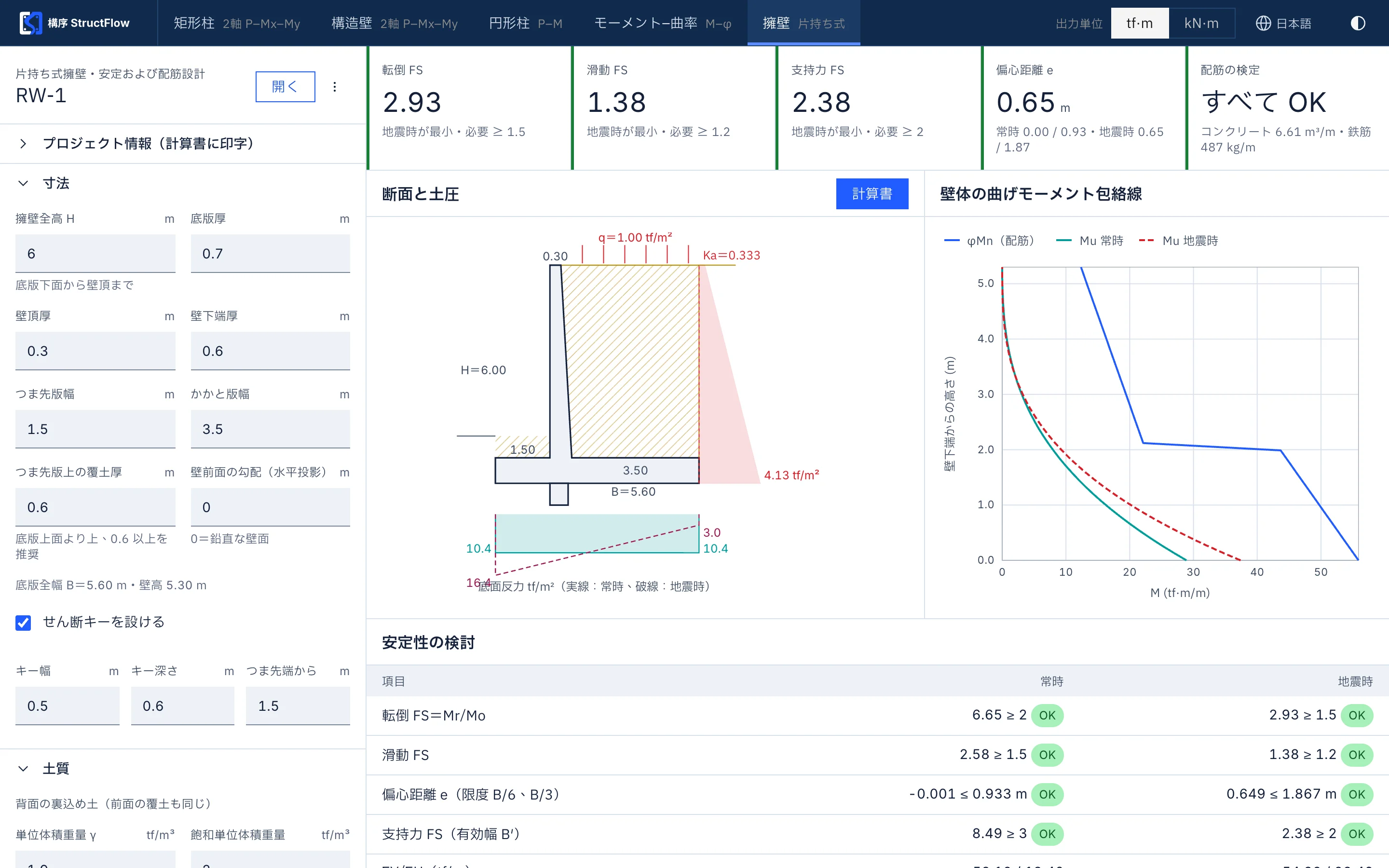
壁体モーメントの包絡
下図は、計算コアが既定の例題に対して実際に計算した結果です。常時と地震時の壁体設計モーメントの高さ方向の分布を、壁体の設計強度 φMn と比較しています。設計強度には主筋の段落とし位置を考慮しています。
対応項目
| 分類 | 項目 |
|---|---|
| 安定性(常時/地震時) | 転倒、滑動(前面の受働土圧とシアキー(突起)を考慮可能)、偏心距離、底面の支持力 |
| 土圧 | 常時の主働・受働土圧、地震時の主働・受働土圧 |
| 水 | 壁背面と壁前面の水位、底版にかかる揚圧力、動水圧 |
| 強度設計 | 壁体、つま先版、かかと版、シアキー(突起)の曲げとせん断、温度鉄筋、定着長さ |
| 自動配筋 | 一般的な間隔と呼び名(番手)の中から、すべての照査を満たし最も経済的な組合せを選定 |
| 出力 | 計算書:設計根拠、作用力と安定性、部材設計、数量 |
参考文献
- Mander, J. B., Priestley, M. J. N., & Park, R. (1988). Theoretical stress-strain model for confined concrete. Journal of Structural Engineering, 114(8), 1804–1826. doi:10.1061/(ASCE)0733-9445(1988)114:8(1804)
- Popovics, S. (1973). A numerical approach to the complete stress-strain curve of concrete. Cement and Concrete Research, 3(5), 583–599. doi:10.1016/0008-8846(73)90096-3
- Whitney, C. S. (1937). Design of reinforced concrete members under flexure or combined flexure and direct compression. ACI Journal Proceedings, 33(3), 483–498. doi:10.14359/8429
- ACI Committee 318. (2019). Building Code Requirements for Structural Concrete (ACI 318-19) and Commentary (ACI 318R-19). American Concrete Institute. doi:10.14359/51716937
- 內政部(Ministry of the Interior, Taiwan). (2023). 建築物混凝土結構設計規範(Design Specifications for Concrete Structures of Buildings),112 年 8 月 10 日修正發布,113 年 1 月 1 日生效. nlma.gov.tw
- 內政部(Ministry of the Interior, Taiwan). (2023). 建築物基礎構造設計規範(Design Specifications for Foundations of Buildings),112 年 6 月 20 日修正發布,113 年 1 月 1 日生效. nlma.gov.tw
- Mononobe, N., & Matsuo, H. (1929). On the determination of earth pressure during earthquakes. Proceedings of the World Engineering Congress, Vol. 9, Tokyo, 177–185.
- Sutherland, I. E., & Hodgman, G. W. (1974). Reentrant polygon clipping. Communications of the ACM, 17(1), 32–42. doi:10.1145/360767.360802
- National Center for Research on Earthquake Engineering (NCREE). 台灣新型高強度鋼筋混凝土(Taiwan New RC)專區. ncree.niar.org.tw/service/newrc
- Chiu, C.-K., Hung, C.-C., Lin, K.-C., Liu, K.-Y., Lee, H.-J., Cheng, M.-Y., et al. (2019). Design Guideline for Building of High-Strength Reinforced Concrete Structures (Draft), NCREE-19-001. National Center for Research on Earthquake Engineering.
- Hung, C.-C., & Li, S.-H. (2013). Three-dimensional model for analysis of high performance fiber reinforced cement-based composites. Composites Part B: Engineering, 45(1), 1441–1447. doi:10.1016/j.compositesb.2012.08.004
- Hung, C.-C., El-Tawil, S., & Chao, S.-H. (2021). A review of developments and challenges for UHPC in structural engineering: Behavior, analysis, and design. Journal of Structural Engineering, 147(9), 03121001. doi:10.1061/(ASCE)ST.1943-541X.0003073
- Shao, Y., Kuo, C.-W., & Hung, C.-C. (2021). Seismic performance of full-scale UHPC-jacket-strengthened RC columns under high axial loads. Engineering Structures, 243, 112657. doi:10.1016/j.engstruct.2021.112657
- Hung, C.-C., Kuo, C.-W., & Shao, Y. (2021). Cast-in-place and prefabricated UHPC jackets for retrofitting shear-deficient RC columns with different axial load levels. Journal of Building Engineering, 44, 103305. doi:10.1016/j.jobe.2021.103305
- Ou, Y.-C., Alrasyid, H., Haber, Z. B., & Lee, H.-J. (2015). Cyclic behavior of precast high-strength reinforced concrete columns. ACI Structural Journal, 112(6), 839–850. doi:10.14359/51687911
- Shen, W.-C., & Hwang, S.-J. (2023). Confinement reinforcement of high-strength reinforced concrete tied columns under high axial load. ACI Structural Journal, 120(3), 145–155. doi:10.14359/51738505