
Abstract
The credibility of structural calculation software rests on reproducible evidence of comparison. The StructFlow calculation core derives from Taiwan New RC high-strength reinforced concrete research and has been verified by professors; the cloud version is additionally verified continuously against four classes of benchmarks: the actual output of the original executable, independent benchmark solutions, checks of mechanical consistency, and hand calculation examples from code formulas and spreadsheets. All benchmarks are written as automated tests, and a new version cannot be released if any one of them fails.
Keywordsverification・point-by-point comparison・benchmark solution・regression testing・traceability
1Verification principles
The calculation core has been verified by professors. The calculation methods of StructFlow derive from New RC research, and the algorithms, parameters, and results have been reviewed and verified by the supervising professors.Comparable point by point with the original. Every detail that affects comparison with the original output follows the original; each difference from the original is recorded with its reason, and the calculation core version is printed on the calculation report.Tests are the gate. Verification is not a one-time report but automated tests that must pass at every deployment; a version that fails is not released.2Verification methods and results
| Item | Benchmark | Result |
|---|---|---|
| Circular column | Actual output of the original executable | Agrees point by point |
| Structural wall | Original input file and actual output | Section and interaction results agree point by point |
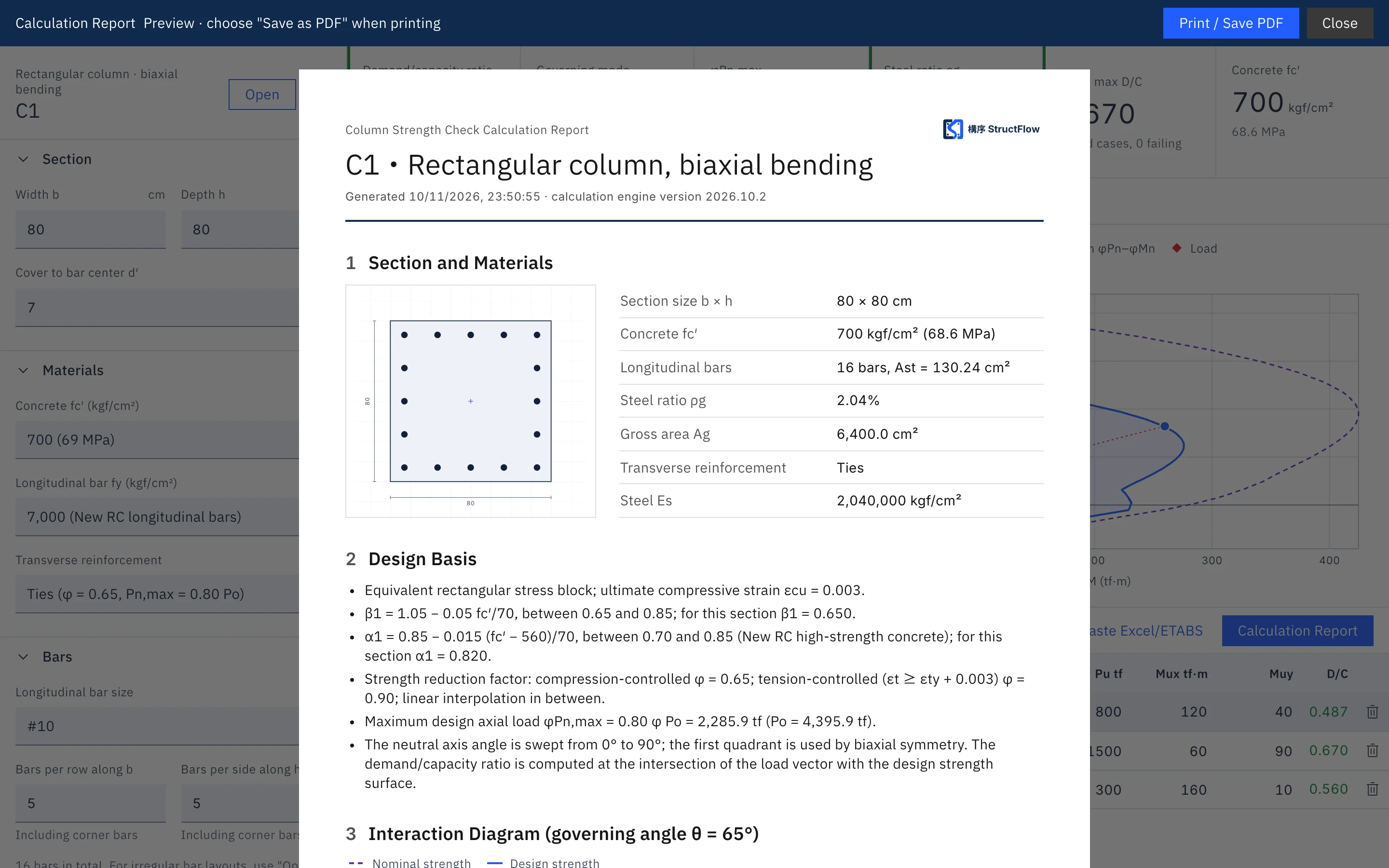
| Rectangular column | Independent benchmark solution (multiple angles) | Differences within 1% |
| Load check | Independent benchmark solution (a large number of random loads) | Identical results |
| Moment–curvature | Mechanical consistency checks | All pass |
| Retaining wall | Spreadsheet examples and hand calculation examples | All pass |
The test programs are version-controlled with the source code and re-run in a clean environment before every deployment.
3Handling differences from the original
Differences in behavior from the original found during the rewrite fall into two categories: those retained as in the original to allow point-by-point comparison, and those improved because they are clearly numerical precision issues. Each entry documents the original behavior, the cloud version's approach, and the effect on results, and changes are made only after confirmation by the research team.
4Continuous verification
Every change to the source code re-runs all tests, type checks, and the production build in a clean environment; if any one fails, deployment is blocked. The calculation report prints the calculation core version, so the same input under the same version always gives the same result.
5Planned further verification
To keep raising confidence, more cross-comparison cases against the original executable and existing commercial software are in progress, and results will be updated on this page.
References
- Mander, J. B., Priestley, M. J. N., & Park, R. (1988). Theoretical stress-strain model for confined concrete. Journal of Structural Engineering, 114(8), 1804–1826. doi:10.1061/(ASCE)0733-9445(1988)114:8(1804)
- Popovics, S. (1973). A numerical approach to the complete stress-strain curve of concrete. Cement and Concrete Research, 3(5), 583–599. doi:10.1016/0008-8846(73)90096-3
- Whitney, C. S. (1937). Design of reinforced concrete members under flexure or combined flexure and direct compression. ACI Journal Proceedings, 33(3), 483–498. doi:10.14359/8429
- ACI Committee 318. (2019). Building Code Requirements for Structural Concrete (ACI 318-19) and Commentary (ACI 318R-19). American Concrete Institute. doi:10.14359/51716937
- 內政部(Ministry of the Interior, Taiwan). (2023). 建築物混凝土結構設計規範(Design Specifications for Concrete Structures of Buildings),112 年 8 月 10 日修正發布,113 年 1 月 1 日生效. nlma.gov.tw
- 內政部(Ministry of the Interior, Taiwan). (2023). 建築物基礎構造設計規範(Design Specifications for Foundations of Buildings),112 年 6 月 20 日修正發布,113 年 1 月 1 日生效. nlma.gov.tw
- Mononobe, N., & Matsuo, H. (1929). On the determination of earth pressure during earthquakes. Proceedings of the World Engineering Congress, Vol. 9, Tokyo, 177–185.
- Sutherland, I. E., & Hodgman, G. W. (1974). Reentrant polygon clipping. Communications of the ACM, 17(1), 32–42. doi:10.1145/360767.360802
- National Center for Research on Earthquake Engineering (NCREE). 台灣新型高強度鋼筋混凝土(Taiwan New RC)專區. ncree.niar.org.tw/service/newrc
- Chiu, C.-K., Hung, C.-C., Lin, K.-C., Liu, K.-Y., Lee, H.-J., Cheng, M.-Y., et al. (2019). Design Guideline for Building of High-Strength Reinforced Concrete Structures (Draft), NCREE-19-001. National Center for Research on Earthquake Engineering.
- Hung, C.-C., & Li, S.-H. (2013). Three-dimensional model for analysis of high performance fiber reinforced cement-based composites. Composites Part B: Engineering, 45(1), 1441–1447. doi:10.1016/j.compositesb.2012.08.004
- Hung, C.-C., El-Tawil, S., & Chao, S.-H. (2021). A review of developments and challenges for UHPC in structural engineering: Behavior, analysis, and design. Journal of Structural Engineering, 147(9), 03121001. doi:10.1061/(ASCE)ST.1943-541X.0003073
- Shao, Y., Kuo, C.-W., & Hung, C.-C. (2021). Seismic performance of full-scale UHPC-jacket-strengthened RC columns under high axial loads. Engineering Structures, 243, 112657. doi:10.1016/j.engstruct.2021.112657
- Hung, C.-C., Kuo, C.-W., & Shao, Y. (2021). Cast-in-place and prefabricated UHPC jackets for retrofitting shear-deficient RC columns with different axial load levels. Journal of Building Engineering, 44, 103305. doi:10.1016/j.jobe.2021.103305
- Ou, Y.-C., Alrasyid, H., Haber, Z. B., & Lee, H.-J. (2015). Cyclic behavior of precast high-strength reinforced concrete columns. ACI Structural Journal, 112(6), 839–850. doi:10.14359/51687911
- Shen, W.-C., & Hwang, S.-J. (2023). Confinement reinforcement of high-strength reinforced concrete tied columns under high axial load. ACI Structural Journal, 120(3), 145–155. doi:10.14359/51738505