
High-Strength RC · Cloud Section Analysis
Research-grade section analysis,
in every structural engineer's browser.
StructFlow turns Taiwan New RC high-strength reinforced concrete research into an engineering tool: biaxial P–Mx–My interaction surfaces, fiber-based moment–curvature analysis, and cantilever retaining wall design. Calculations run in the cloud, and every result comes with a complete calculation report.
Calculation core verified by professors · Point-by-point comparison with the original research program · No installation
Engineering-grade computation
From research program to engineering tool: the same mechanics, faster and traceable.
The original New RC research program is a desktop executable. StructFlow rewrites it as a cloud calculation core whose results agree with the original point by point, with both speed and precision improved.
- Biaxial interaction surface
- ≈ 4ms
- Load combination checks
- 2,000combos / 80 ms
- Concrete strength range
- 21–100MPa
- Calculation tools
- 5tools
Rectangular column, θ every 5°, 2,622 sample points
Paste a large number of ETABS-exported loads at once
Includes the New RC modified α1 and β1
Column, wall, circular column, moment–curvature, retaining wall
Five tools, one workspace
Five calculation tools, one workspace.
Each tool lets you enter or import a section, see results instantly, and export a calculation report. Units switch between tf·m and kN·m, and the interface is available in Traditional Chinese, English, Japanese, and Korean.
Rectangular column, biaxial
Interaction surface at any neutral-axis angle with a continuous demand/capacity ratio; paste tens of thousands of ETABS load cases.
Learn more →P–Mx–MyStructural wall, biaxial
Parametric input of wall length, thickness, two boundary elements, and double-layer web reinforcement, matching the original output point by point.
Learn more →P–MCircular column P–M
Strength reduction and axial load limits for spiral and tied confinement, compared point by point with the original executable output.
Learn more →M–φMoment–curvature fiber analysis
Mander, HUNG (HPFRCC), and UHPC jacket concrete models, with curves plotted side by side to compare ductility.
Learn more →Code 112Cantilever retaining wall design
Static and seismic stability, member strength design, and automatic reinforcement selection per the 2023 (ROC 112) edition of the codes.
Learn more →ReportCalculation reports and project files
Print or save as PDF in one click; project files and share links keep review and handover documented.
Learn more →Verified by professors
A calculation core verified by professors.
The StructFlow calculation core derives from Taiwan New RC high-strength reinforced concrete research and has been verified by the supervising professors. The cloud version is also compared point by point with the actual output of the original research program, and is released only when results agree. Every update must pass the same automated verification again, and the calculation report prints the calculation core version so that results are traceable.
Reproducible, comparable, traceable
Circular columns and structural walls: compared point by point with the actual output of the original executable, with agreeing results.
Rectangular columns and load checks: compared with independent benchmark solutions, with differences within engineering tolerance.
Every update must pass all verification again before release.
Built for daily design work
Built for everyday design work.
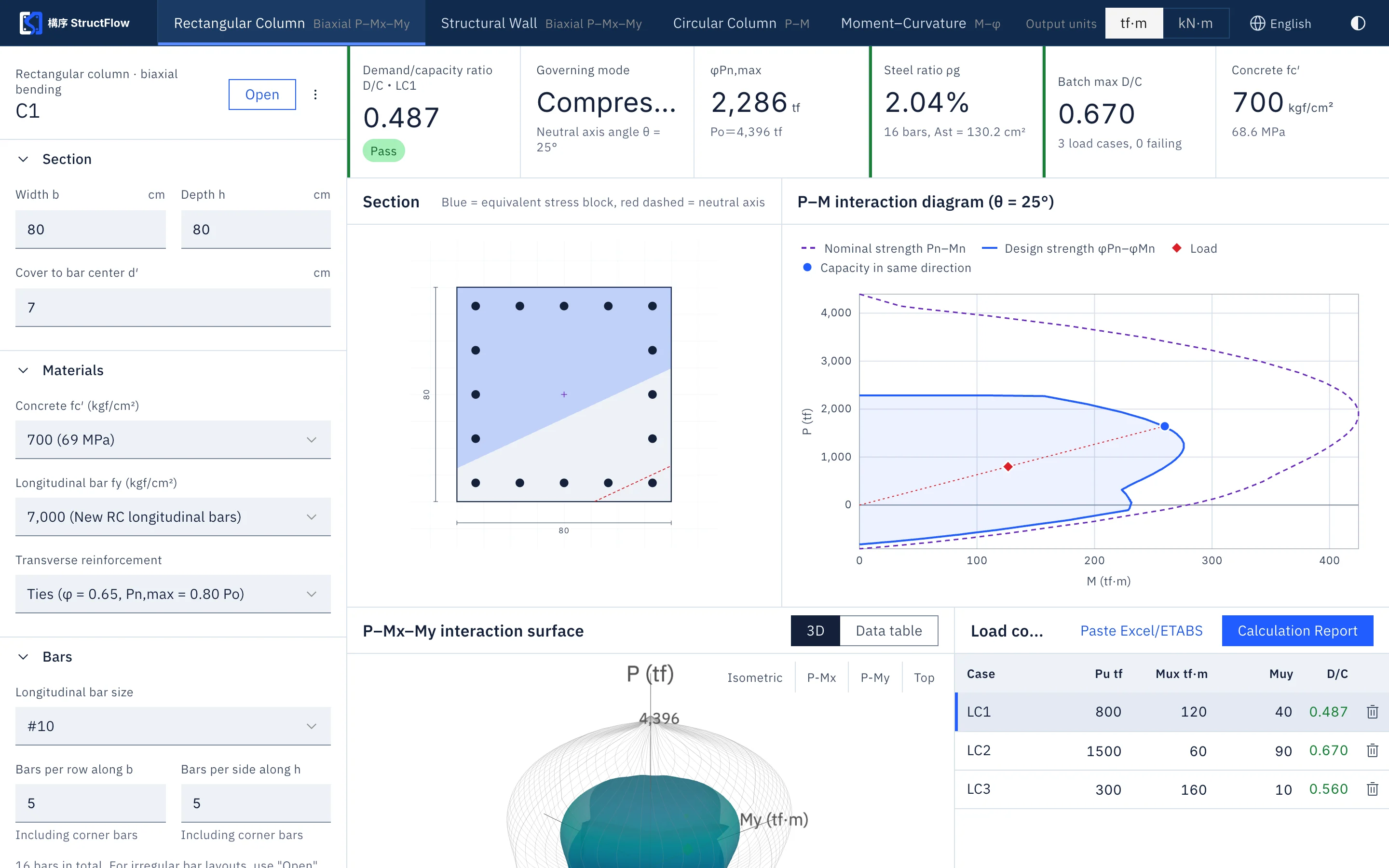
01 · Interaction surface
3D interaction surface with instant D/C
Enter a section and the nominal and design strength surfaces are computed immediately; every load case gets a continuous, stable demand/capacity ratio that is unaffected by jumps in sampling angle.
02 · Calculation report
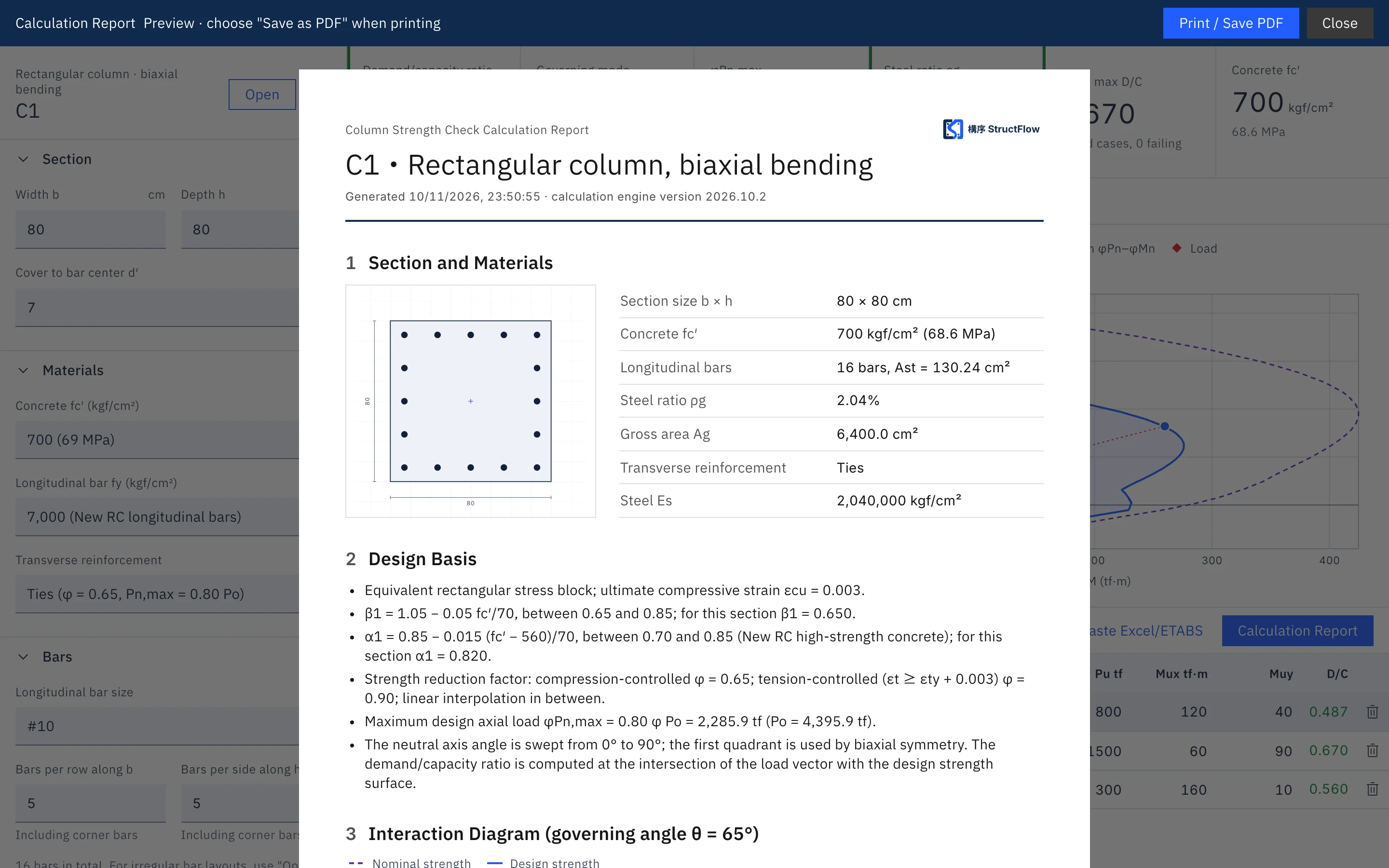
One-click calculation report
The report lists the design basis, material parameters, interaction diagrams, and check tables, and states the calculation core version and source. Print it or save it as a PDF to attach to submittals.
03 · Retaining wall
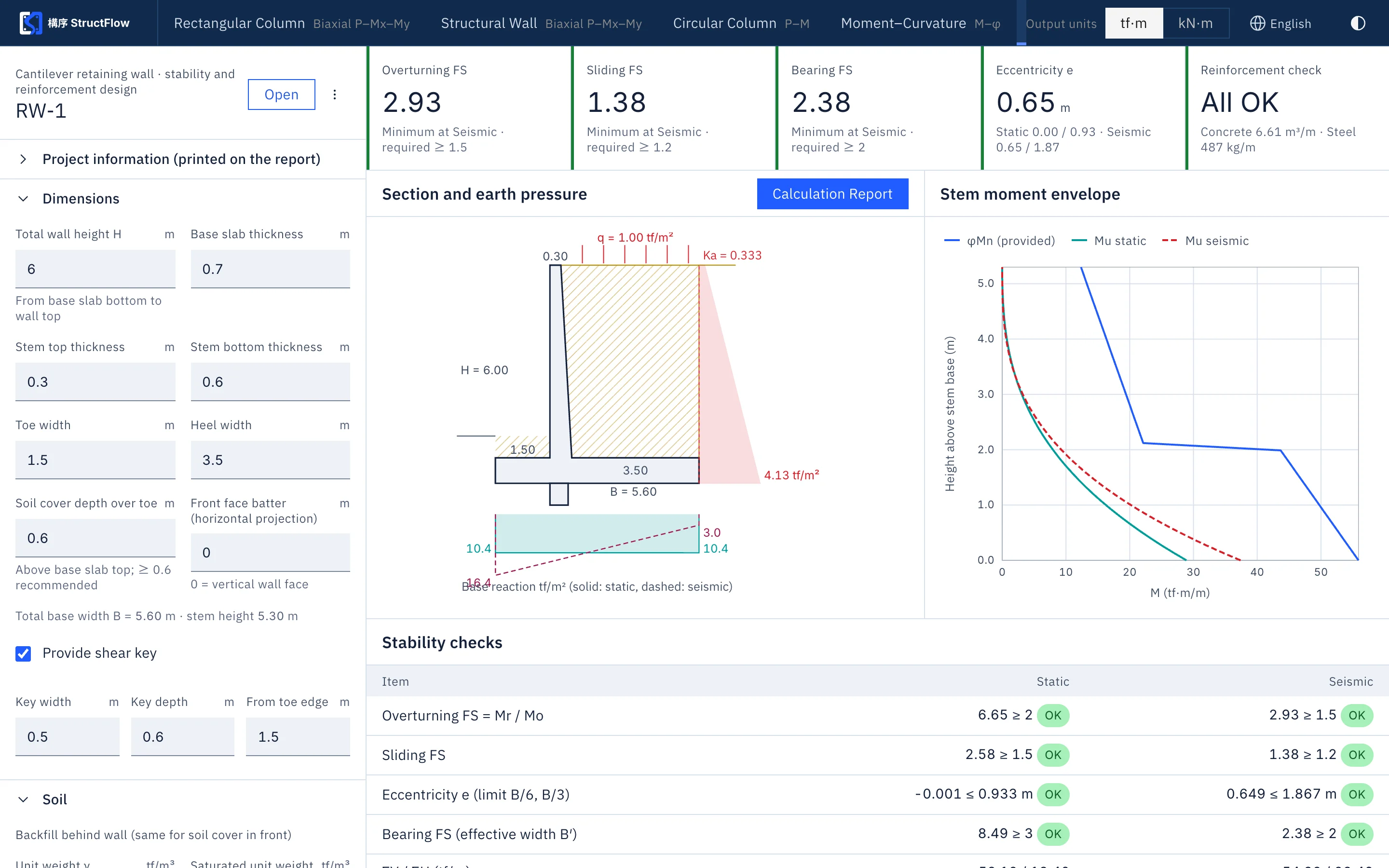
Cantilever retaining walls: from stability to reinforcement
Following the 2023 (ROC 112) edition of the foundation and concrete structure design specifications, it completes the overturning, sliding, eccentricity, bearing, and member strength checks, and automatically selects the most economical reinforcement combination.
Workflow
Three steps from section to calculation report.
- 01
Enter or import
Enter the section and reinforcement parametrically, or open the original research program's txt input file directly; loads can be pasted from Excel or ETABS tables.
- 02
Cloud calculation
Calculation runs in the cloud. Works on laptops and tablets, with no installation and no tie to a single computer.
- 03
Check and deliver
Read the check results on surfaces and curves, export the calculation report, and save a project file or share a link with reviewers.
Core technology
Core technology at a glance.
For a technical overview, see Technology. The complete design basis, parameters, and check procedure are listed item by item in the calculation report after you sign up.
Exact compression zone
The compression zone is computed directly and exactly, with none of the discretization error of conventional fiber slicing.
Continuous D/C
The demand/capacity ratio is unaffected by jumps in sampling angle, so check results are stable.
Multiple concrete models
Mander confined, HPFRCC, and UHPC jacket models, compared side by side for ductility.
Cloud computation
The calculation core runs only in the cloud; every update passes automated verification.
Do today's design with research-grade tools.
Sign up free with a SUHUL EIP account and start a 14-day trial right away; no credit card required, and no automatic charge when the trial ends.